
Description
HOME STUDIO FOR DIGITAL AUDIO RECORDING
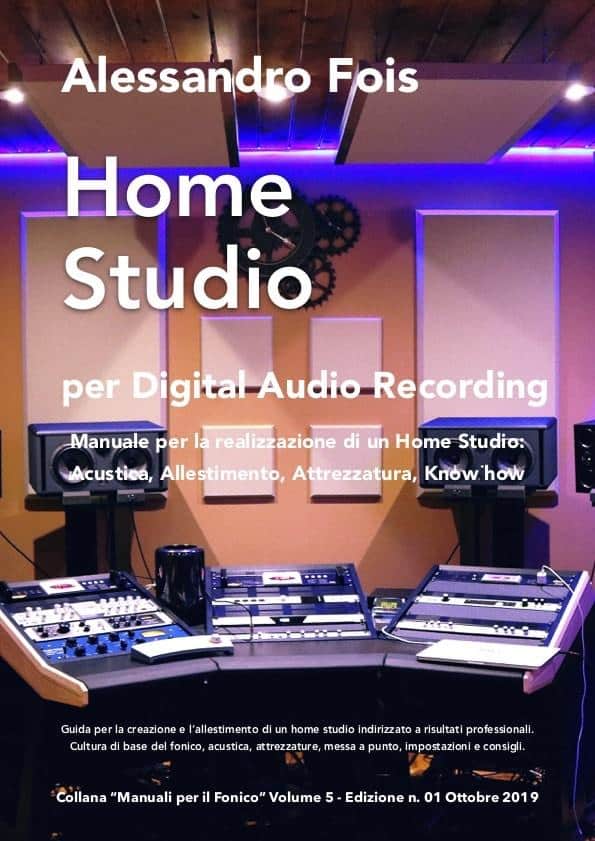
Home Studio Setup Guide: Acoustics, Setup, Equipment, Know-How
A guide to creating and setting up a home studio for professional results. Basic sound engineering knowledge, acoustics, equipment, setup, settings, and tips.
Format 21 x 29 cm (A4) – Pages 428 – More than 180 illustrations with captions
***
INDEX
Preface
Part 1 – BASIC CULTURE
01 – SOUND AND WAVEFORM
Sounds
Noises
Waveform, phase and phase problems
The sound wave
Harmonic motion
Wave superposition and phasing
Polarity reversal
Time lag
Harmonic Generation
The Hammond organ drawbars
The beat
Tartini's Third Sound
Composite resultant wave
Phase problems during recording and mixing
Chorus via time shift (delay)
02 – MUSICAL SOUND PARAMETERS
Height
Stamp
Stamp components
Manipulation of the stamp
Intensity
Dynamics
Dynamic excursion
Average dynamics and average intensity
Lufs
Dynamic variation within a single sound
Envelope
ADSR
Attack
Decay
Sustain
Release
The synthesizer
Waveforms in sound synthesis
03 – PROPAGATION AND USE OF SOUND
Speed of sound and wavelength
Sound propagation and obstacles
Echo
Reverb
Spatiality
Sound directivity simulation
Monophony
Stereophony
Quadraphony
Surround
Octophony and point systems
Presence and proximity
Perception of volume and sustain
Ideal volume for critical listening
Sound level meter
04 – ANALOG AND DIGITAL
High definition digital
Comparison of definition and dynamics in recording
The sampling
Bits and dynamics
The quality audio chain
Aliasing
Signal levels
The analog signal
The digital signal
The limits of the floating point
The Montgomery test
The sound
The future of digital
A personal opinion
05 – THE VALUE OF MUSIC
Purpose of music nowadays
Filling underlay
Game support
Narrative support
The abstract narration of music
The growth of awareness
Music Influences and Classifications
Popular, classical, commercial music
Ethno-geographical and historical-cultural influence
The technological revolution in music
Globalizing and liberalist influence
06 – THE MUSICAL ELEMENTS
Technical analysis of musical elements
Melody
Keys, modes, scales and intervals
Diatonic system and chromaticism, comma, cent, tuning
Harmony and chords
Rhythm and groove
Dynamics, punctuation, bearing
Themes, structures and styles
Arrangement and orchestration
Critical listening
Part 2 – ACOUSTICS AND SETTING
07 – CHOICE OF LOCATION
Limitations of the home studio
The rooms
Acoustic recording room
Control room
Single or double room
Ideal proportions and dimensions of the studio
Rooms with unsuitable shape and size
Control room orientation
08 – SOUND INSULATION
Purpose of sound insulation
First: Do not disturb
Second: Don't get disturbed
Third: isolate the rooms from each other
How to proceed with soundproofing the studio
Floating floor
Floating side counter walls – long side
Splaying of the walls
Floating false walls front and back – short side
Suspended false ceiling
The dividing wall between the control room and the recording room
Insulation and acoustic optimization, common remedies
Final considerations
Insulating cabins
Movable partition panels
Soundproof doors
09 – ACOUSTICS AND STUDIO SETUP
The path of sound
Propagation
Obstacles
Standing waves
Calculating the basic modal resonance
Axial, tangential and oblique modal resonances
Modal multiples
Schroeder frequency
Calculate all modal resonances
Frequency response analysis
The large rooms
Critical distance
Echo and flutter echo
Acoustic Troubleshooting
Room selection
Flutter echo elimination
Elimination of early reflections
General bass reduction
Selective bass reduction
Diffusion and homogenization of the mids and highs
Reverberation time optimization
Using EQ for acoustic correction
Standing Waves and Drum Tuning
Visual communication between rooms
Intercom for sound communication between rooms
10 – MONITORS AND MONITORING
The main monitor speakers
The subwoofer
Alternative monitors
Positioning of the listening point and monitors
Stereo image
General criteria
Modal nodes and listening point
First retrospective reflection
Early lateral reflections and comb filter
Subwoofer placement and calibration
Some advice
Environmental equalization
Linearity check with musical notes
Critical listening volume during monitoring
Critical evaluation of low frequencies
Medium mix test
Monitoring for the recording room
The speakers for the main room
Monitors for communication
Auxiliary lines for monitoring
Headphone preamplifiers
The connection panels
Headphones
How to proceed
Pre or post fader monitoring
Managing latency
11 – WIRING AND AUDIO SIGNAL
The acoustic signal
The acoustic transducer
The electroacoustic signal
Balanced and unbalanced conductors
Electromagnetic disturbances and shielded cables
Balanced line cables
Unbalanced line cables
Balanced and unbalanced stereo cables
Hardware processors, amplifiers and speakers
Preamplifier inputs
Micro
Line
Instrument
Signal levels
Noise level
Attendance band
Nominal level
Headroom band
Distortion and clipping level
The gain levels to use in the preamplifier
Part 3 – EQUIPMENT
12 – COMPUTERS AND PERIPHERALS
CPU and DSP
Ram
HD, SSD, RAID
Fine-tuning your computer settings
Updates
Energy
Archive indexing
Journaling
Multitasking
13 – DAW AND CONVERTERS
DAW Settings
H/W Buffer size
Host processor
Usage limit
Delay compensation engine
Cache Size (Pro Tools)
Disk cache
The most useful plugins for the DAW
Time adjuster
Stereo Phase Correlation Viewer
Gain
Equalizer
Single-band compressor
Multiband compressor
Reverb
Echo/Delay
Exciter
Saturator
Inflator
Metering
Analyzers
Generators
14 – MICROPHONES
A little history
The transducers
Dynamic microphone
Ribbon microphone
Condenser microphone
Tube microphone
The membrane
Shooting angle and polar diagram
Dual-diaphragm microphones
Frequency response
Impedance
Sensitivity
Dynamic space
Dynamic speed
Distortion and electromechanical resistance
Choosing a microphone park
Some suggestions
15 – PREAMPLIFIERS
Input
Micro
Line
Instrument
Controls
Input selector
Phantom
Pad
Micro impedance selector
Line level selector
Input gain
Input level LEDs
High-pass filter
Output gain
Output level LEDs
Output
16 – OTHER EQUIPMENT
Mixer and controller
Analog Outboards
MIDI system, interface, musical keyboard
Virtual instruments and grooves
Plugin format
General Music Format and Sound Libraries
Grooves
Microphone stands and supports
Cables
Furnishings
Toolbox
CONCLUSION
Know-how
The sound engineer and the artistic director
In conclusion
Further information
Publications
How to buy
Book conventions
Services
Seminars and partnerships
Copyright
Information and licenses


 Italian
  English
  French
  Spanish
  German
Reviews
There are no reviews yet.