
Analogue and digital audio recording: considerations and comparisons(Letto 216 volte)
Analog audio and digital audio

In the figure: on the left, the schematic representation of the wave correlated with the analog signal, and on the right (the dotted part) that correlated with the digital signal. The idea is to suggest that the definition of the sound wave, in the digital system, appears as a series of information related to an intensity level, discontinuous and more or less closely spaced, represented by dots. By increasing the number of dots (thereby increasing the resolution of the digital system), the information will merge into a continuous line, indistinguishable from the analog one. Similarly, the idea is to suggest (not entirely accurate) that in the analog system, the definition can instead be represented as a continuous line, the result of the connection of infinite points.
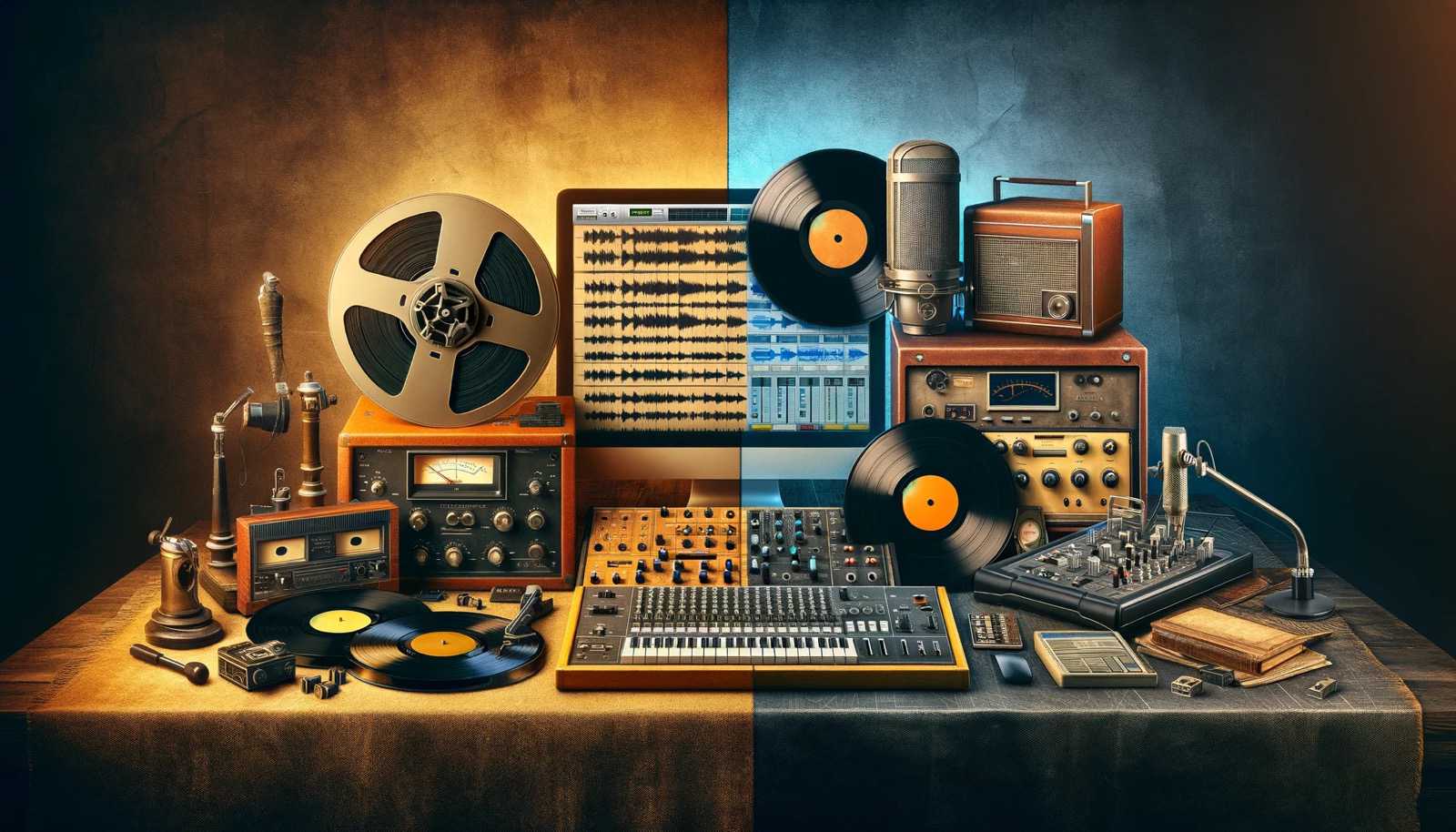
The ongoing discussion among supporters of theanalog and those of the digital.
If it can be of any reference, I would not mind quoting the opinion of a musician considered one of the greatest conductors of all time: Herbert von Karajan, who already in the 1980s firmly affirmed the absolute superiority of digital in reproducing the infinite tonal and dynamic nuances of the large symphony orchestra.
When asked in terms of absolute quality, however, the question makes little sense, as digital and analog audio processes are simply different, and both have their pros and cons.
Through a simple direct comparison between the two worlds, we will be able to affirm something more, as we will see.
Before continuing, we underline that, beyond the quality comparison, the digital controls of the DAW They will provide us with some indisputable practical advantages, not obtainable in the analog field:
- significantly lower purchase costs
- no wear and tear and no maintenance time and cost
- saving space in the studio
- reduced connection times and no wiring required
- reduction of the risk of malfunctions, which can be resolved with a simple reboot
- possibility of replicating infinite "instances" of the same plugin in the same work session (that is to say: I buy 1 and use 100 at the same time)
- storage of infinite setting memories
High definition digital
Comparison of definition and dynamics during recording
Let's start with a comparison between analog and digital based on two very important parameters, namely definition and dynamics, which can be found during multitrack recording and during master production.
First of all, however, allow me to make some clarifications:
It's important to dispel the "absolute" idea that analog lacks any sort of limited "resolution" or "definition," no matter how high. The supposed "continuity of magnetic information" of analog tape is an abstract idea that only takes on conceptual meaning when compared to digital, as it has no real correspondence in the real world. In fact, iron oxide, which allows for the magnetic storage of sound information, is composed of microscopic granules whose size effectively constitutes a "measure of resolution," differently but similarly to digital.
Empirical evidence of the above influence is highlighted by comparing the results obtained using different tape speeds: higher speeds, in fact, improve the linearity of the response, especially at high frequencies, as well as significantly improving overall fidelity; this occurs because each doubling of the speed doubles the number of magnetic information read by the head; which is similar to what happens in the digital field when the sampling frequency is doubling.
The “definition” of analog, however, behaves differently from digital, as the storage of magnetic information is not schematic as in digital: a lowering of the tape speed will in fact correspond to a decrease in non-linear fidelity, which will determine a deformation of the sound that will still remain “listenable” and not “grainy”, as well as “absent” at high frequencies, as would happen in digital by decreasing the sampling frequency to just 24 Khz or even 12 Khz.
With digital having sampling frequencies of 44.1 kHz and above, however, fidelity comparisons between the two systems take on greater practical significance.
MASTER PRODUCTION
ANALOG
A master engraved on stereo analog tape with a 1/2 inch width at high speed (30 IPS), thus using 1/4 inch for each mono track), produces excellent results in terms of definition and good results in terms of dynamics.
N.B.
30 IPS = 30 inches per second = 30 inches per second = approximately 76.2 cm per second

Ampex 456 Grand Master Tape, one of the most popular analog mastering tapes
DIGITAL
To reach a different level of definition, but in fact comparable to the above, it will be necessary sample in digital to 24 bit at a frequency of 96 Khz.
In this way, very similar results will be obtained for digital in terms of definition, but clearly superior in terms of dynamics thanks to the greater dynamic space determined by the bit depth.

Detail of the head assembly of a 24-track analog recorder
MULTITRACK RECORDING
ANALOG
Excellent results, but a little less high in terms of dynamics and definition, can be obtained by working with great care and skill even during multi-track analog recording on 2-inch magnetic tape (24 tracks on 2 inches = 1/12 of an inch for a mono track) at a speed of 15 IPS (a speed not always used, with the speed of 7.5 IPS being more often preferred, in order to save, as in the case of the 50%, on the very considerable cost of magnetic tape of this type).
Reducing the speed reduced the definition and above all the dynamic range in terms of signal-to-noise ratio.
In such systems, the crosstalk caused by the concomitance of the tracks on the tape increases compared to the less significant crosstalk present in the master tape; however, maintains at a good level.
To keep the noise level relatively low and increase the effective dynamic range, noise reduction processes are often used and, when possible, the recording level is pushed to the highest values that the digital tape can tolerate, giving the sound a color induced by progressive saturation, capable of modifying and, in a certain sense, enriching its harmonic content, which is often considered an advantage, but not always.
A practical method to manage crosstalk in a controlled way is to use the side bands of the tape for the more delicate sources, also avoiding placing them next to other sources having high energy and a similar frequency range (for example, it was sometimes used to use tracks 01, 02 and 03 of the 24-track recorder for the HH and the cymbals, leaving track 04 empty and continuing from the next track with the more energetic sources such as the snare drum, the bass, and so on.
DIGITAL
In terms of pure definition, when recording digitally at 24 bit – 48 Khz, it could be said that you will get results that are slightly lower than those recorded in analog at 15 IPS, or slightly higher than those recorded at 7.5 IPS).
Digital will surpass analog in perceived definition using 96Khz multitrack sessions.
In terms of dynamics, 24-bit or higher digital audio will be significantly superior, allowing for more “relaxed” processing in terms of level management during audio manipulation, thanks to the abundant dynamic range that is practically free from noise.
Digital crosstalk is almost non-existent, as it can only be produced during the A/D conversion phase, and only in the case of simultaneous recording of multiple tracks.
Digital, by its nature, is linear at any recording level and therefore does not offer the possibility of creating progressive saturation depending on the recording levels (which can also have a creative value).
In exchange, it offers better fidelity in terms of closer correspondence to the original sound input into the recording.
The sampling
Sampling at 48 kHz solved some of the problems initially posed by 44.1 kHz; subsequently, with 96 kHz, sampling was further optimized during the production process.
In the opinion of many sound engineers, the advantage offered by 192 or 384 kHz sampling is more virtual than real: these systems offer little or no appreciable advantage, while taking away significant power resources from the system, both in terms of recording and processing.
The use of 88.2 Khz and 96 Khz files, on the other hand, has its valid reasons, especially in the audio manipulation phases, while it can be excessive for files intended for the end user.

Above is a loosely schematic-conceptual representation of the analog definition of a sine wave, represented by a black line (in reality, the absolute continuity of the line is more virtual than real) compared to its digital copies sampled at different sampling frequencies. It's clear that doubling the frequency allows for a greater number of coordinates relating to the wave's various levels of intensity and polarity in space and time. This results in a more faithful reconstruction of the original sine wave.
Bits and dynamics
Let's better evaluate the useful dynamic space.
Digital systems at 16 bit they offer a range of 96 db, equal to or slightly lower than that of professional analog which, at its best, thanks to the notable tolerance of the magnetic medium, could give us a few more dB.
This advantage of analog is theoretical, however, due to the higher level of noise associated with analog recording, which subtracts a few dozen dB from the dynamic range in the lower part of its extension.
Signal-to-noise ratio
To put it simply, the best professional analog cameras are capable of reproducing a signal-to-noise ratio (signal-to-noise ratio) ranging between 55 dB and 73 dB, depending on the quality of the tape and the recorder, the width of the magnetic stripe of the tape and the speed of movement used.
By means of circuitry Dolby, used especially during the multitrack recording but sometimes also during the mastering on stereo trackthe signal-to-noise ratio it could be increased by about 10-12 dB, reaching a useful dynamic range of 85 dB, very notable but still inferior to that of 16-bit digital systems.
The advent of 24-bit
With the advent of 24-bit technology, the digital audio production process has taken a significant step forward.
In fact, each single bit is able to encode 6 dB of dynamic range, which means that with 24 bits we will have 48 dB more dynamic space compared to the 96 dB of the 16-bit “system”, for a total of 144 dB useful.
This allowed us to virtually eliminate any background noise induced by the sampling process itself (except for imperfections in the A/D converters, depending on the quality), allowing us to operate with levels that are even significantly lower than usual, also in order to prevent any risk of accidental clipping and to avoid unwanted saturation effects.
Further benefits came when 64-bit DAWs and floating point encoding were introduced.
Such systems would have a very high theoretical dynamic range, but they would still have to compete with 24-bit A/D and D/A conversion systems.
This does not produce an appreciable increase in terms of quality or dynamics in the produced file, but rather optimizes the management of dynamics during audio processing in order to:
- Avoid clipping during rendering
- Dramatically reduce numerical rounding errors occurring during signal processing
- allow the DAW and 32 or 64 bit plugins to work in a "native" way, avoiding clipping (NB: in experimental practice this is always true in 32 or 64 bit "precise" plugins, depending on the case, while it is not always true in many "colored" plugins, such as some emulated equalizers and compressors)
The quality audio chain
To maintain a high level of quality, each link in the digital chain must not show any failures in:
- virtual instruments
- A/D and D/A converters
- DAW
- plugins
- any other related elements
Furthermore, another important element in addition to the individual quality of the components is the optimization of compatibility between them in terms of sampling frequency and number of bits.
Each of the above elements should offer very high quality, and the working session should be set to the minimum value of 44.1 Khz or 48.0
If resources allow, even better at 88.2 or 96 Khz
The above, sampling at 24 bits or more, while maintaining the convenient advantages offered in the field of dynamic resource management.
Aliasing
To avoid or mitigate aliasing, every good-quality A/D converter should have an anti-aliasing filter at the input. Otherwise, using a low-pass filter with a very steep slope, placed between the input source and the converter, may solve the problem.

Low-pass filter. Here it is set to a cutoff of 12 kHz and a slope of 24 dB per octave. For proper anti-aliasing use, it should have a very steep slope (60 dB/oct or more) and a cutoff frequency of 20 kHz.
This solution, obviously, will limit the frequency response of the audio program within the boundaries of audibility, which has pros and cons, which I will outline below:
PRO – in systems capable of sampling and correctly reproducing frequencies higher than the audible range, which the built-in anti-aliasing filter will limit to 96 and 192 Khz (depending on the system in use), ultrasonic frequencies can contribute to obtaining subtractive reactions in the audible range similar to what happens in acoustics, contributing to coloring the sound of the audible band in a more natural way, thanks to the contribution of frequencies and beats that would otherwise be lost.
AGAINST – in the same high-frequency sampling, the sound engineer will not be able to have acoustic control over any distortions induced at high frequencies in the inaudible range, which could produce (by subtraction) unwanted harmonics in the audible range, creating a notable degradation of audio quality, which is as insidious as it is intolerable.
A more effective anti-aliasing action is achieved by using an anti-aliasing filter combined with an oversampling process, offered by converters and plugins, always recommended when available.
Inter-Sample and Over-Sample Distortion
Speaking of aliasing, we know that the converters they use an interpolation process between 2 contiguous samples, in order to recreate a simulation of continuous sampling values, similar to the analog system.
This results in an upward rounding of the intensity values of two adjacent samples.
It will therefore be clear to understand that, by pushing a digital signal to values close to or equal to 0 dB, theinterpolation itself will create a distortion.
This risk will be greater the lower the sampling frequency of the sampling (and hence its resolution), forcing the system to produce interpolation curves wider in order to compensate for a larger gap between the two adjacent samples.
Furthermore, certain audio manipulation processes may create peaks so rapid that they exceed the peak point. digital clipping.

The above diagram shows a digital waveform, which is defined as the result of the level coordinates expressed by the individual samples. The interpolation process intervenes to "round" the values around these levels, thus obtaining a more harmonious "virtual continuous line." When a digital value approaches the 0 dB level, clipping will tend to occur due to the overload of the rounding values created by the interpolation curve.
N.B.
Both risks are particularly sensitive when exporting an audio file following a mastering process.
And even when converting and reconverting a master to and from an audio format that uses data compression processes (mp3, aac, etc.) it will be possible to run into the problem of accidentally exceeding the clipping limit.
DC offset
In the audio recording, a DC offset is an undesirable characteristic of a recorded sound.
It occurs in the capture of sound, before it reaches the recorder, and is sometimes caused by obsolete, defective, or low-quality analog equipment.
THE'offset makes the “balance” center of the waveform not stay at 0 dB, but at a slightly higher or lower value.
This could cause two possible problems:
- clipping of peaks, if the base of the waveform has been raised – hence the first advice is to monitor the levels of the audio program already during recording, to avoid unexpected distortions
- a low frequency distortion
Once digitized into an audio track, the problem should be eliminated by means of a specific function in the DAW, if present (DC offset removal).
Typically, this function will also allow us to analyze a “suspicious” file in order to diagnose and eliminate the problem.
In case the DAW does not have one, the application of a high-pass filter with drastic cutting below the audible band (20hz or even much lower) should still eliminate the problem.
In addition to the risk of clipping, the presence of DC offset It could also affect the response of a dynamics compressor, so it is always a good idea to eliminate it as soon as possible.

Representation of a waveform with DC Offset (above) and the same normalized (below).
The Montgomery test
Below is a quick summary of a research carried out by theengineer Christopher Montgomery (creator of the format file TODAY and careful scholar of audio sampling and acoustic perception), which involved the execution of numerous tests over the course of an entire year, involving a good number of audiophiles, among whom were various "insiders".
The aim of the test was to verify whether a good number of expert listeners were actually able to distinguish betweencomparative listening between audio files containing the same sound program but sampled at different sampling frequencies.
TEST RESULT
None of the aforementioned expert listeners were ever able to distinguish with any reliable certainty any difference between audio files coming from sources sampled in very high definition, and those converted by them to different combinations of frequency and number of bits.
As for the bit, it should be clarified that the process of processing an audio file subjects the latter to a loss of dynamics, so it is advisable to always work with a high number of bits, thus being able to grant the processes a wide margin of tolerance, in order to avoid any risk of distortion.
The reduction of the definition to 16 bit it is now tolerable only at the end of the work, through an appropriate process of dithering which minimizes any handicaps induced by the final conversion.
Final summary
-
-
- it will be sufficient to use the frequencies of 44.1 or 48 Khz both in the audio processing and in producing audio files intended for the end user
- If the resources of your audio recording and processing system allow it, it is advisable to use 88.2 or 96 Khz during the production and subsequent manipulation of the audio, while higher frequencies would be redundant.
- in particular, the mastering processes, not requiring a very high expenditure of resources from the DAW, should be carried out in oversampling, with frequencies double those of the mix
- The use of 24 bits or more will be essential when manipulating audio and when exporting an archive master, while their use may be considered optional when exporting files intended for end users, for which operation 16 bits would be absolutely sufficient.
- The use of floating point systems is always advisable to make level management in the DAW more practical, faster and safer.
-
Regarding the sampling frequencies of the 176.4, 192, 352.8 and 384 Khz systems, given the lack of any feedback regarding their quality that emerged during the tests, Montgomery himself decreed their dubious usefulness.
The sound
Using an appropriate number of bits and sampling rates for digital, it is no longer possible to define any superiority between digital and analog in terms of pure sound quality, as both offer very different advantages and disadvantages, and therefore are difficult to compare. However, we will attempt to summarize them below to highlight their characteristic differences.
- Digital:
- Cleanliness and ClarityDigital systems tend to produce very clean, clear recordings, with almost no background noise.
- Fidelity: High fidelity in the reproduction of the original sound, with minimal colorations or alterations.
- DynamicsWide dynamic range, especially with 24-bit formats and higher. The dynamic range of the sources is faithfully respected.
- Rustle: The background noise of the system itself is non-existent, although in practice it can be induced to a very small extent by the input and output converters.
- Analog:
- Warmth and CharacterAnalog recordings are often described as “warmer” and “fuller,” with a certain sonic coloration that can be aesthetically pleasing, although this is actually an alteration, due to elements that have nothing to do with the original sources, but rather induced by tape fluctuations and the harmonic distortion process of the tape and the equipment.
- Natural Saturation: When tape is overloaded, it produces a harmonic saturation that many find musically pleasing.
- Dynamics: Dynamic range is generally more limited than digital; at high dynamic ranges, sources tend to be slightly compressed both due to the relative saturation of the preamplifiers and the “dynamic containment effort” of the magnetic tape.
- Rustle: Background noise (such as tape hiss) can be more noticeable, however when it is below the audible level it contributes to coloring the sound, making it sound dirtier but also enriched in timbre fullness.
The future of digital
The history of every technology teaches us that traditional processes reach an insurmountable pinnacle of evolution, while new processes take their first modest steps.
This was the case for analog which, when digital appeared, was indisputably superior to it in almost every respect.
In recent years we have witnessed a qualitative juxtaposition of the two technologies, despite the differences that suggest the possibility of an intelligent interaction between the two worlds.
In the future, it will be inevitable that digital will almost entirely replace analogue, as it will be increasingly able to emulate its qualities and character (it is already doing so), while also developing new and exclusive ones, governable through the undoubted and notable practical advantages inherent in digital management.
There are a thousand “urban legends” that accompany many traditional devices which, when undoubtedly of excellent quality, are often considered “mythological”, sometimes surpassing objective reality with their myth.
Beyond the quality, the special color of a hardware equalizer is something unique, and so is the progressive reactivity induced by a tube dynamics processor.
The above justifies the affection and worship of many sound engineers, who continue to prefer its use.
The quality and success of high-end analog processors is also confirmed by the effort made by many software designers, in order to emulate the most celebrated hardware devices, designing them in the form of plugins, with sometimes surprising results.
A personal opinion
Having worked in the field of analog recording at the beginning of my career, I understand that many sound engineers like the sonic dimension created by magnetic tape and hardware processors.
In this context, however, any honest comparison is often distorted by individual preferences, while what counts is the search for objective quality aimed at the goal to be achieved.
As far as processing is concerned, I have had several opportunities to make direct comparisons between the performance of some of the best analog processors and the most refined digital plugins installed in the best DAWs.
I have often preferred digital in the area of tonal control and sometimes even in dynamics, while in other cases the opposite occurred.
In general, I could say that:
Precise digital equalizers are generally preferable in the context of surgical equalization, for example during the preliminary stages of equalization aimed at cleaning the sound from unwanted resonances, thanks to their millimetric precision in locating and controlling the tonal spectrum in a highly selective manner, without introducing any type of coloration; they are also often preferable in passive timbre coloration operations, that is, when they are used to attenuate a group of frequencies.
when it comes to active timbre coloration, that is, when trying to amplify a tonal range, I often achieve more satisfying results with analog EQs but also with their digital emulators (I often use Neve and Pultec), some of which now lead to impressive results even in terms of compliance with the corresponding hardware model.
In the dynamic field I could perhaps say that precise digital compressors allow for detailed and neutral control of the general dynamics of the tracks, while analog compressors and their digital emulators, although less precise, tend to smooth out dynamic sharpness in a more "adaptable" way and to enrich the harmonic spectrum in a modulated manner, contributing to making the sound rich, gritty and warm.

Image of the famous Universal Audio 1176 hardware compressor (above) and two versions of its emulator in the Waves version, the CLA-76.
Some high-quality analog machines also have their own unique and pleasant “color,” which some of the most successful plugin emulators have partially conveyed to us.
Consequently, at this stage the choice will depend on the specific case being treated, personal tastes, the available budget, and the ability to manage the different problems inherent in both digital and analog.
As usual, a lack of prejudice will be the best guide for your choices and will allow you to build a “mixed” setup, which includes the integration of some analog elements in a modern digital context.
For further reading, we recommend this publication:
A Handbook on Digital Audio Recording, Editing and Tuning
 Italian
  English
  French
  Spanish
  German
Leave a Reply
Want to join the discussion?Feel free to contribute!