The invention of the piano is attributed to Bartolomeo Cristofori (1655–1731) from Padua, who was employed by Ferdinando de’ Medici, Grand Prince of Tuscany, as custodian of the family's musical instruments.
Cristofori was an expert builder of harpsichords and other keyboard and stringed instruments; this knowledge of keyboard mechanisms helped him to develop the first pianos.
It is not known exactly when Cristofori first built a piano; an inventory made by the Medici family indicates the existence of a piano in 1700; the three pianos built by Cristofori that still survive today date back to the 1720s. Cristofori called the instrument “a cypress cembalo with piano and forte”, which was then abbreviated to fortepiano and finally to pianoforte.
Cristofori's great success was determined by the innovative design of a stringed keyboard instrument, in which the notes are struck.by a hammer.
The hammer had to strike the string, but not remain in contact with it, because prolonged contact would dampen the sound, preventing the string from vibrating and producing sound.
After striking the string, the hammer must therefore bounce away from the strings and come to rest smoothly in its resting position, avoiding multiple bounces and being ready to strike again almost immediately after its key has been pressed, so that the pianist can quickly repeat the same note if necessary.
Cristofori's first instruments were made with thin strings and were not capable of producing the same volume as the modern piano; however, the volume produced and also the duration of the sound support was significantly higher than that obtainable with the clavichord, which until then was the only keyboard instrument capable of reproducing dynamic nuances responding to the pianist's touch through the speed with which he pressed the keys.
Although the clavichord allowed for expressive control of volume and sustain, it is relatively quiet. The two-manual harpsichord, on the other hand, produced a sufficiently loud sound when a “coupler” linked each key to both keyboards, but it offered no expressive dynamic control over individual notes.
In a sense, the piano finally offered the best of both previous instruments, combining high volume with a wide dynamic range in response to touch.
Cristofori's new instrument remained relatively unknown until an Italian writer, Scipione Maffei, wrote an enthusiastic article about it in 1711, including a diagram of the mechanism, which was translated into German and widely distributed. Most of the next generation of piano makers began their work by reading this article.
The ancestor of the sustain pedal
One such builder was Gottfried Silbermann, better known as an organ builder. Silbermann's pianos were in fact direct copies of Cristofori's, with one important addition: Silbermann invented the precursor to the modern sustain pedal, which simultaneously lifts all the dampers from the strings. This innovation allowed the pianist to sustain the notes pressed even after releasing the keys. Therefore, by holding a chord with the sustain pedal, pianists could move their hands to a different register of the keyboard to play other notes.
Silbermann showed Johann Sebastian Bach one of his first instruments in the 1730s, but Bach did not like it at the time, explaining that the higher notes were too delicate to allow for a full dynamic range. Although this earned him some animosity from Silbermann, the criticism was heeded, so much so that Bach subsequently “approved” a piano in 1747 and finally even acted as an agent for the sale of Silbermann's pianos.
The Viennese School and the fortepiano
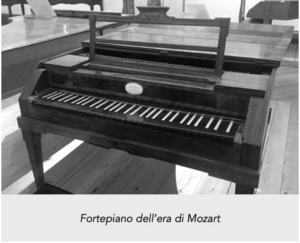
Piano construction flourished during the late 18th century in the Viennese school, thanks to Johann Andreas Stein (who worked in Augsburg, Germany) and the manufacturers Nannette Streicher (daughter ofStein) and Anton Walter. Viennese-style pianos were constructed with wooden frames, two strings per note and leather-covered hammers. The keyboards of these Viennese pianos had the opposite colouring to that of modern pianos: the keys for the “natural” notes were black and those for the “altered” notes were white. It was for these instruments that Wolfgang Amadeus Mozart composed his concertos and sonatas; they are still replicated today in order to reproduce the “authentic” sound of Mozart's music at the time. Pianos from Mozart's time produced a less intense sound than modern pianos. The term fortepiano distinguishes this vintage instrument from the piano of more recent times.
Between 1790 and 1860, the Mozart-era piano underwent enormous changes that led to the modern structure of the instrument. This revolution responded to the desire of composers and pianists for a more powerful and sustained piano sound. It was made possible by the industrial revolution, which produced new resources such as high-quality harmonic wire for the strings and a more precise casting process for the production of metal frames capable of withstanding the tremendous tension of the strings. The tonal range of the piano was also gradually increased from Mozart's five octaves to the seven octaves of modern pianos.
The advent of the seven octaves
Around 1777, Scotsmen John Broadwood and Robert Stodart joined forces with Dutchman AmericusBackers designed and built a piano inserted into a harpsichord cabinet, which was the origin of the term “grand piano”. In this way, they quickly earned an excellent reputation for the aesthetic splendour and powerful sound of their instruments, while offering increasingly larger, sturdier pianos with powerful sound volume. They made several pianos for Joseph Haydn and Ludwig van Beethoven and were the first to build pianos with a range of more than five octaves, specifically: five octaves and a fifth in 1790, six octaves in 1810 (Beethoven used the extra notes in his later works) and seven octaves in 1820. Viennese luthiers also followed this new trend, sacrificing some of the instrument's volume for greater range and expressive capacity.
The dual exhaust system
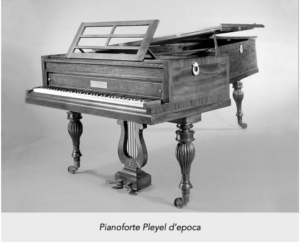
By 1820, the centre of piano development had shifted to Paris, where the Pleyel company produced pianos, the same ones that were later used by Frédéric Chopin, while the Érard company produced those that were later used by Franz Liszt. In 1821, Sébastien Érard invented the dual exhaust which, thanks to a repetition lever (called a balancier), allowed a note to be repeated even if the key had not yet returned completely to its resting position. This greatly facilitated the rapid reproduction of repeated notes, and Liszt immediately exploited this new capability of the instrument. The double escapement action thus gradually became standard in grand pianos, where it is still used today. Other improvements to the mechanism included the use of solid felt coverings instead of layers of leather or cotton. Felt, which Jean-Henri Pape was the first to use in pianos in 1826, was a more robust material that allowed for wider dynamic ranges as the weight of the hammers and the tension of the strings increased. The modern sustain pedal, which allowed for a wider range of effects, was invented in 1844 by Jean-Louis Boisselot and was copied by Steinway in 1874.
The cast iron harp and the harmonic wire
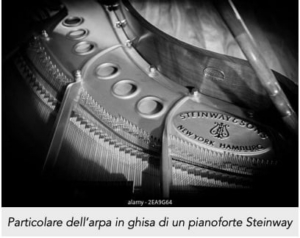
One innovation that helped create the powerful sound of the modern piano was the use of a solid, durable cast iron frame. Also called the “plate”, the frame sits on top of the soundboard and acts as the main bulwark against the force exerted by the tension of the strings, which in a modern grand piano can exceed 20 tonnes. The one-piece cast iron frame was patented in 1825 in Boston by Alpheus Babcock. Babcock later worked for Chickering & Mackays, the company that patented the first solid metal frame for grand pianos in 1843. Composite forged metal frames were preferred by many European manufacturers until the American system was fully adopted in the early 20th century. The greater structural integrity of the metal frame allowed for the use of thicker, tighter and more numerous strings. In 1834, the Webster & Horsfall company in Birmingham launched a form of cast steel harmonious wire; it was so much superior to iron wire that the English company effectively gained a monopoly on the manufacture of strings. But an even better steel wire was soon created in 1840 by Martin Miller's Vienna-based company; a period of innovation and intense competition followed, with rival brands of harmonious wire pitted against each other.the other in international competitions, ultimately leading to the modern form of the harmonic wire.
The capo and the crossed strings
Several important advances included changes to the way the piano was strung. The use of a “choir” of three strings, rather than two for all (except the lowest notes, which were single-strung), enhanced the richness and complexity of the treble. The use of a Capo d'Astro bar (or nut) instead of staples in the highest treble range allowed the hammers to strike the strings in their optimal position, greatly increasing the power of sound in that area. The implementation of the cross-stringing system, in which the strings are positioned on two separate planes, each with its own bridge, allowed for longer bass strings and optimised the transition from the unwound treble strings to the iron or copper-wound bass strings. Over-stringing was invented by Pape in the 1820s and first patented for use in grand pianos in the United States by Henry Steinway Junior in 1859.
Some piano makers added variations to improve the sound of each note, such as Pascal Taskin (1788), Collard & Collard (1821) and Julius Blüthne, who developed the Aliquot stringing in 1893.
These systems were used to reinforce the sound of the higher register of the piano, which until then had been considered too weak. Each used more distinctly ringing, undamped vibrations of sympathetic strings to add to the sound, with the exception of Blüthner Aliquot strings, which use an additional fourth string in the two upper sections. Eager to replicate these effects, Theodore Steinway invented duplex scaling to increase vibrations for sympathy.
The square piano
Some of the earliest pianos had shapes anddesigns that are no longer in use; the so-called square piano (which was not actually square, but rectangular) was stretched out in a cross shape with an extremely acute angle above the hammers, with the keyboard arranged along the long side. This design is attributed to Christian Ernst Friderici (a pupil of Gottfried Silbermann in Germany) and Johannes Zumpe (in England) and was improved by changes first introduced by Guillaume-Lebrecht Petzold in France and Alpheus Babcock in the United States. Square pianos were built in large numbers between 1840 in Europe and 1890 in the United States and constituted the most macroscopic change in piano style: the iron-framed, overstrung squares produced by Steinway & Sons were twice as bulky as the wooden-framed instruments of a century earlier. Their overwhelming popularity was due to their construction and relatively low price, although their sound and performance were limited by narrow soundboards, basic mechanics and string spacing that made it difficult to align the hammers correctly.
The upright grand piano
The vertical grand piano, with vertical strings, was constructed like the horizontal grand piano, with the soundboard and bridges above the keys and the tuning pegs below them; therefore, they were very tall and given evocative names such as Giraffe Piano or Pyramid Piano, and were often decorated in keeping with their name; they were built in the 19th century. The tiny upright spinet was produced from the mid-1830s until recent times. The low position of the hammers required the use of a ’falling action“ to maintain a reasonable keyboard height.
The modern piano
Modern upright and grand pianos had reached their current forms by the end of the 19th century; improvements were subsequently made to the manufacturing processes, and many details of the instrument continue to evolve.
Since the 2010s, some acoustic pianos have been equipped with MIDI interfaces and a digital audio module.
Evolving styles
Many classical composers, including Haydn, Mozart and Beethoven, composed for the fortepiano, an instrument quite different from the modern piano. Composers of the Romantic movement, such as Franz Liszt, Frédéric Chopin, Clara and Robert Schumann, Fanny and Felix Mendelssohn, and Johannes Brahms, also wrote for pianos very different from modern pianos. Contemporary musicians must therefore adapt their interpretation of historical compositions from 1600 to 1800 according to differences in sound quality and performance technique.
Starting with Beethoven, the fortepiano evolved into an instrument more similar to the modern piano of the 2000s, which was widely used at the end of the 19th century. It had a wider octave range than the previous fortepiano instrument, adding about 30 more keys to the instrument, which extended thedeep bass range and high treble range. The popular production of upright pianos made them more accessible to a larger number of middle-class people. They appeared in music halls and pubs during the 19th century, providing entertainment with a piano soloist or in combination with a small dance band. Just as harpsichordists had accompanied singers or dancers performing on stage or played for dances, pianists took on this role in the late 1700s and in the centuries that followed.
During the 19th century, American musicians who played for working-class audiences in small pubs and bars, particularly African-American composers, developed new musical genres based on the modern piano. Ragtime music, popularised by composers such as Scott Joplin, reached a wider audience in the 1900s; the popularity of ragtime music was quickly replaced by jazz “pianism”. New techniques and rhythms were invented for the piano, including the so-called “ostinato” for boogie-woogie and the Voicing by Shearing. George Gershwin's Rhapsody in Blue opened up new musical horizons by combining American jazz piano with symphonic sounds. The Comping, a technique for accompanying singers and other jazz soloists on the piano, was exemplified by Duke Ellington's technique. Honky-tonk music, characterised by a different style of piano rhythm, borrowed from blues and the forerunner of rock ’n“ roll, became popular during the same era. Bebop techniques emerged from jazz, with important composer-pianists such as Thelonious Monk and Bud Powell. At the end of the 20th century, Bill Evans composed pieces that combined classical techniques with his jazz experimentation. In the 1970s, Herbie Hancock was one of the first jazz composer-pianists to find popularity with new urban music techniques, such as jazz-funk, jazz-rock and other ”fusion' genres (a fusion of genres and musical currents into a new hybrid style).
Pianos have also been used prominently in rock and roll and rock music by artists such as Jerry Lee Lewis, Little Richard, Keith Emerson (Emerson, Lake & Palmer), Elton John, Ben Folds, Billy Joel, Nicky Hopkins, and Tori Amos, to name a few. Modernist musical styles have also stimulated the work of composers writing for the modern grand piano, including John Cage and Philip Glass.
The mechanical action structure of the upright piano was invented in London, England, in 1826 by Robert Wornum, and upright models became the most popular and widespread model for domestic use.
Role of the piano
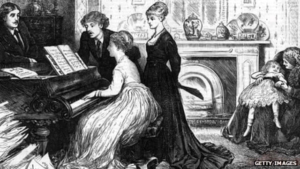
The piano was the centrepiece of social life in the homes of the upper middle class in the 19th century.
It is an important instrument in Western classical music, jazz, blues, rock, folk music and many other Western musical genres. Pianos are used in solo or melodic roles or as accompanying instruments. In addition, pianos can be played alone, in a duo with a singer or another instrument, in small groups (bands and chamber music ensembles) and large ensembles (big bands or orchestras).
A large number of composers and songwriters are skilled pianists because the piano keyboard provides an effective means of experimenting with complex melodic and harmonic interactions of chords and performing multiple independent melodic lines simultaneously. Pianos are used by composers who create soundtracks for films and television, as the wide range allows composers to try out melodies and bass lines, even if the music will subsequently be orchestrated for other instrumental ensembles.
Orchestra and choir conductors often learn to play the piano, as it is an excellent instrument for learning new pieces and songs to conduct during performances. Many orchestra conductors also have piano training, which allows them to play a condensed version of the orchestral pieces they will be conducting (often using a “piano reduction”), so that they can work out the interpretative criteria before communicating them to the orchestra.
The piano is an essential instrument in music education. Most music classrooms and many rehearsal rooms have a resident piano. Pianos are used as teaching aids in music theory and music history classes and in music education lessons; therefore, even music teachers who are not pianists often have a piano in their office.
Per approfondimenti ti segnaliamo questa pubblicazione:
https://alessandrofois.com/wp-content/uploads/2025/06/12-2.jpg626795Alessandro Foishttp://alessandrofois.com/wp-content/uploads/2025/06/Logo-Alessandro-Fois-Solid-Web.pngAlessandro Fois2023-06-06 00:30:502026-07-30 20:42:38A brief history of the piano
0replies
Leave a Reply
Want to join the discussion? Feel free to contribute!
We may request cookies to be set on your device. We use cookies to let us know when you visit our websites, how you interact with us, to enrich your user experience, and to customize your relationship with our website.
Click on the different category headings to find out more. You can also change some of your preferences. Note that blocking some types of cookies may impact your experience on our websites and the services we are able to offer.
Essential Website Cookies
These cookies are strictly necessary to provide you with services available through our website and to use some of its features.
Because these cookies are strictly necessary to deliver the website, refusing them will have impact how our site functions. You always can block or delete cookies by changing your browser settings and force blocking all cookies on this website. But this will always prompt you to accept/refuse cookies when revisiting our site.
We fully respect if you want to refuse cookies but to avoid asking you again and again kindly allow us to store a cookie for that. You are free to opt out any time or opt in for other cookies to get a better experience. If you refuse cookies we will remove all set cookies in our domain.
We provide you with a list of stored cookies on your computer in our domain so you can check what we stored. Due to security reasons we are not able to show or modify cookies from other domains. You can check these in your browser security settings.
Other external services
We also use different external services like Google Webfonts, Google Maps, and external Video providers. Since these providers may collect personal data like your IP address we allow you to block them here. Please be aware that this might heavily reduce the functionality and appearance of our site. Changes will take effect once you reload the page.
Google Webfont Settings:
Google Map Settings:
Google reCaptcha Settings:
Vimeo and Youtube video embeds:
Privacy Policy
You can read about our cookies and privacy settings in detail on our Privacy Policy Page.









 Italian
  English
  French
  Spanish
  German
Leave a Reply
Want to join the discussion?Feel free to contribute!