
Voice recording: pop protection, distance from the microphone and its inclination.(Letto 100 volte)

Distance from the microphone
Let's assume we have a large, ideally sized professional room, acoustically treated with state-of-the-art engineering. Imagine placing the microphone in an ideal spot in the room, close to but not directly opposite the center. This will create a neutral, pleasant acoustic coloration induced by the environment.
In this case it will be possible to move the microphone considerably away from the singer's mouth, up to a considerable distance of 50 cm, which will have some positive effects, including:
- reduction of the incidence of more aggressive consonants, which will be more "rounded" and natural
- total elimination of air turbulence
- almost total elimination of the proximity effect, which manifests itself with a progressive tonal emphasis of the low frequencies
- greater incidence of resonances in the singer's head, neck and chest, capable of giving the voice an even more natural sound
- feeling of spatiality around the source
It goes without saying that in small recording studios and in the case of imperfect or insufficient acoustic correction of the same, it is advisable for the singer to assume a position closer to the microphone, in order to minimize the negative influence induced by environmental reflections.
To sum up, the ideal distance would be somewhat close to 50 cm, while the minimum usable distance should be no less than 10 cm.
In most professional studio applications, a distance of 20 to 30 cm will be the best choice, while in home studios with imperfect acoustic treatment it may be necessary to reduce the distance by half (10 – 15 cm)
As the distance doubles, the sound pressure on the microphone will decrease, forcing us to increase the preamplifier gain level (by about 6 dB). To do this, the microphone and preamplifier must be sufficiently quiet, especially when recording delicate vocal sources (with low output volume) or relatively high ambient noise.
For more delicate voices, the sensitivity of a microphone will also be important: a less sensitive microphone may not be able to capture the dynamic and tonal details accurately enough.
Microphone tilt
To reduce the incidence of detonating and blowing consonants, it is often appropriate to tilt the microphone appropriately. In this case, the capsule should be positioned approximately at nose height and directed towards the mouth, with an inclination of approximately 20° or 30° (see figure below). This inclination is highly recommended in the case of a very close microphone (10-20°). cm) while it would lose its meaning when moving away from it (30 cm and beyond).
Anti-pop and elastic support
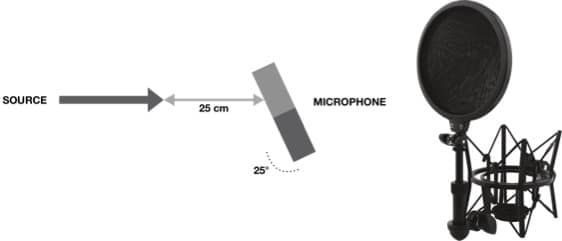 Even the use of a anti-pop stocking (see figure) is particularly recommended to avoid the incidence of detonating and blowing consonants, and can also be used in conjunction with the inclination of the above-mentioned microphone. The pop shield is also a safeguard for the microphone, as it protects it from humidity caused by small "spits" involuntarily emitted by the singer. As with the inclination, the use of the pop shield is also highly recommended in case of very close positioning (15-20 cm) while it gradually loses significance as you move away (30 cm and beyond). Another recommended element is the elastic shock mount (see figure on the side), which allows you to largely isolate the microphone from the vibrations induced on the microphone stand and on the floor; its use becomes more important if a high gain value is used in the preamplifier.
For more information on Audio Recording, Editing and Digital Tuning
For further reading, we recommend this publication:
Voice Recording, Editing and Mixing

 Italian
  English
  French
  Spanish
  German
Leave a Reply
Want to join the discussion?Feel free to contribute!