
Stereo recording of the voice(Letto 85 volte)

Stereo recording of the voice
You will rarely feel the need to record a lead vocal in stereo.
In fact, when necessary, a “stereophonization” of the monophonic vocal source is often generated by means of processors such as delays, modulators, the harmonizer, or even by recording the vocal performance on 3 parallel tracks positioned on the left, center (the main one) and right.
However, when recording very sparse arrangements we may feel the need to make an ambient recording, which may be inadvisable in very small recording rooms and/or with imperfect acoustic treatment due to the greater incidence of poor quality ambient sound that would penetrate the recording audio program.
For stereo recording of the voice we can distinguish between:
1 – Stereo recording of the voice with L/R technique
It involves recording the voice by positioning two microphones in stereo, choosing between the following techniques:
Variable XY technique
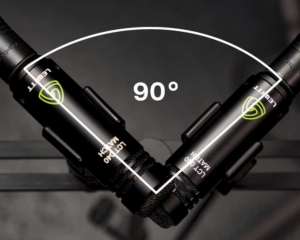

It involves placing two identical microphones one on top of the other in front of the singer's mouth, so as to obtain a perfect coincidence of the capsules, which must touch each other (without touching) in correspondence with the source axis coming from the singer's mouth.
The microphones must be oriented, one to the right and the other to the left, so as to form an identical but opposite angle with the aforementioned axis, having a standard measurement of approximately 45° for each microphone (which means that the angle between them will be 90°); alternatively, this angle may be reduced from 90° to a minimum of 60° or expanded to a maximum of 120°.
Narrowing the angle will result in a narrowing of the stereo field and a decrease in the incidence of environmental reflections, while widening the angle will achieve exactly the opposite; the environmental incidence will be lower in acoustically large rooms and well treated – the coherence of the stereo phase is almost absolute.
ORTF Technique

The axis between the two capsules, obviously, must be perfectly aligned with the axis protruding from the singer's mouth.
This recording will produce a very natural but very ambient sound, so its use is generally limited to sufficiently large recording rooms with properly treated acoustics; the coherence of the stereo phase is good.
Spacing technique
It is obtained with two identical microphones positioned, one to the right and the other to the left of the singer, so that, with a 45° inclination, they direct the capsules towards the singer's mouth, at a distance of approximately 20 cm from it.
This recording technique produces a wider stereo dimension, maintaining acceptable stereo phase coherence and a more moderate ambience compared to the ORTF technique.
It is also possible to place a sound-absorbing screen between the capsules of two microphones, perpendicular to the axis of voice emission.
The advantage of these various techniques is that they produce a very natural and pleasant sound, which can be appreciated in acoustically well-set up recording rooms.
The disadvantage is that they don't produce a decidedly dry sound, which is often a necessary requirement for many applications, especially in the pop field.
Mono recording of the source + stereo ambient field
This mode, which uses 3 recording channels instead of two as in the previous examples, is most commonly used as it is considered more useful and versatile in most applications.
It involves recording the voice in mono as usual, and simultaneously making a take stereo of the ambient field which can then be adjusted as desired during the mix.
The positioning of the 2 microphones to be used for the ambient field can be left to the creativity of the sound engineer, thus obtaining personalized effects. vocal ambient field.
However, there are two main suggestions, which can be used alternatively as desired:
- Place two identical studio microphones in the Blumlein position, both with a figure-8 polar pattern, overlapping them on the vertical axis as in the XY technique above (see figure at right); the angle between the two microphones on the horizontal axis must be exactly 90°; position these microphones behind the singer at the back of the room, approximately one-third of the way down;
- Place two identical studio microphones in a cardioid position behind the singer at the back of the room, approximately 1/3 of the way down, so that they are 1/3 and 2/3 of the way down the room, pointing them towards the ceiling.
When mixing, this stereo pair of microphones could be useful to give a touch of naturalness to the vocals in the mix, a very interesting solution especially for small acoustic groups, provided that the recording room “sounds good”.
2 – Stereo recording of the voice using M/S technique

- n.1 cardioid positioned frontally towards the voice, which will be dedicated to the recording main (as if it were a normal standard mono recording)
- n.1 with a figure 8 polar pattern, oriented perpendicularly to the first microphone (with a 90° angle), so as to record the right and left sides of the room (see figure)
Microphone no. 2 will not pick up the direct voice but only the reflected one thanks to the double counterphase recording which (virtually) cancels the sound coming from a 90° angle on both sides.
This microphone, on the other hand, will perfectly capture the reflections induced by the voice on the environment.
At the end of the registration we will have:
- an M (middle) channel with the direct sound of the source, in mono, recorded by microphone no. 1
- an S (side) channel with the reflected sound of the source, in mono, taken by microphone no. 2
At this point, we'll need to duplicate the S track and phase-invert it (only the duplicated one), assigning the original entirely to the left channel via the panpot, and the duplicated one entirely to the right channel. The M track, on the other hand, should remain centered.
At this point we will have built a sort of stereophony which will also allow us to independently adjust the direct sound and the reflected sound converted to stereo.
Phase coherence is total since, in case of listening in mono, the L and R channels, being identical but inverted in phase, would cancel each other out, leaving only the M track containing the direct sound.
Creative variation of the MS technique
Instead of the single microphone no. 2 with a figure of 8, no. 2 identical microphones with a cardioid polar pattern should be used, with the capsules overlapping until they almost touch each other, pointed in opposite directions, perpendicular to microphone no. 1 (always 90°).
A highly effective sound-absorbing acoustic screen must be placed between the singer and these microphones, capable of preventing the direct sound from being picked up by the two lateral microphones.
The central microphone capsule no. 1 should appear above the screen, pointing towards the singer's mouth.
At this point, the 3 tracks will be "pan-fried" as before:
- the central microphone (M) in the center
- the other 2 microphones, one completely to the right and the other completely to the left
Now you will have obtained something similar to before, that is, a direct central channel and 2 side channels containing essentially the reflected sound, mixable independently.
However, there are some differences that will correspond to some advantages and just as many disadvantages:
- the side channels will also contain a small part of the direct sound, in addition to the reflected sound, with the risk of shifting part of the direct sound if the S channel is kept at a very high volume
- The stereo sensation offered by the S channel is more natural than the pure M/S system
- you can decide to use the S microphones by leaving them in phase or by inverting the polarity of one of them: you will obtain slightly different results between which you can choose (generally it will be better to leave them in phase)
- the phase correlation will be decreased but the center channel will not suffer substantially, which will allow you to still perceive some ambient reflected sound even when listening in mono
For more information on Audio Recording, Editing and Digital Tuning
For further reading, we recommend this publication:
Voice Recording, Editing and Mixing

 Italian
  English
  French
  Spanish
  German
Leave a Reply
Want to join the discussion?Feel free to contribute!