
Reflection and Absorption: What They Are and How They Affect Recording and Mixing(Letto 188 volte)

Introductory note
This article provides a general overview of sound reflection and absorption, fundamental phenomena for recording and mixing. In future articles, we will explore in detail the practical applications and specific solutions for optimizing acoustics in audio environments.
Reflection and Absorption: What They Are and How They Affect Recording and Mixing
When a sound wave encounters an obstacle, it can be transmitted through it, absorbed, or reflected. These phenomena significantly affect the quality of audio recordings and mixing, determining how sound is captured and perceived in listening environments. Understanding how sound behaves in relation to obstacles is crucial to achieving clear recordings and balanced mixes.
Sound Passage and Absorption


Sound can pass through an obstacle, being absorbed or reflected, depending on the characteristics of the obstacle itself and the frequency of the sound. An obstacle with low mass and a low sound frequency allows sound to pass through, while denser materials absorb sound more, especially at high frequencies. This principle is the basis of sound insulation, essential for preventing unwanted sound leakage.
Reflection of Sound
To reflect sound effectively, the obstacle must be rigid, smooth, and elastic. High frequencies can be reflected even by thin surfaces like plastic or metal, while very dense materials like concrete or stone are needed to reflect low frequencies.
Angles of Incidence and Refraction
Sound follows the same laws as light and the motion of a billiard ball: it bounces off a reflective surface at the same angle at which it hits. If the obstacle is perfectly flat, the reflection will be predictable and directed. By tilting the plane of reflection, you can direct the reflection wherever you want, following the same geometry used to control a billiard ball.
Concave and Convex Surfaces
Concave surfaces tend to concentrate sound in a specific point, creating unwanted accumulations of sound energy. Conversely, convex surfaces diffuse sound more evenly, reducing sound focusing problems. This concept underpins the use of diffusion panels, which disperse the incoming sound energy, improving the acoustics of a room.

In a closed environment, every propagation path of a source encounters obstacles that cause as many reflections. S+P indicates a sound source whose producer is also a listener to himself (for example, a singer or a violinist): note the shortest of the three highlighted reflections, which determines the pre-delay time as a function of the length of the shortest path. For the external listener or recording microphone (Only P), the pre-delay will also be a function of the shortest reflection path. Both will also hear the direct sound, which for S+P is immediate, while for Only P it will be slightly more delayed, depending on the distance, but still more immediate than any other reflection.
Effects of Refraction: Echo and Reverberation
Reflection is the main cause of phenomena such as echo and reverberation, which affect the perception of sound in an environment.
- EchoThis occurs when a reflection is delayed enough to be perceived as a separate sound. The delay between the original sound and the echo depends on the distance from the reflecting surface. The greater the distance, the greater the delay.
- Flutter EchoIt's a repeated, close-range echo caused by reflections between parallel, untreated surfaces. It's a serious problem in recording studios, which can be solved by tilting the walls or installing absorbent panels.
- ReverbIt is the result of the superposition of multiple echoes, which create a persistent sound tail. The amount of reverberation in a room depends on the number of reflective surfaces and their distance from the sound source.

The sound emitted by a source, after a few moments, will be perceived by the listener as "direct sound." A little later (after a latency period called "predelay") the listener will perceive the "first reflections," which gradually become closer and denser, until they merge into a single perception of "reverberation." Note how all events follow one another with a progressive loss of sonic energy, until the resonance is completely extinguished.
Practical Implications for Recording and Mixing
Registration:
- Check the First RefractionsSound waves bouncing off nearby walls bounce back to the microphone and can create phase interference, distorting the recorded sound. Treating the walls with absorbent panels or diffusers helps prevent this problem.
- Avoid Unwanted RefractionsExcessive reflection makes the sound muddy, while excessive absorption makes it sound unnatural and lacks depth. The right balance between absorption and reflection is essential for clear recordings.
Mixing:
- Managing ReverbA key parameter is pre-delay, or the time between the original sound and the reverberated response. Setting an appropriate pre-delay helps separate the direct sound from its reverberated tail, maintaining clarity and intelligibility.
- Studio MonitorsUsing studio monitors instead of regular speakers is essential for accurately evaluating your mix. Professional monitors have a linear frequency response, which prevents unwanted coloration of the sound.
- Using Headphones and Acoustic CorrectionWhile mixing is best done with monitors, headphones can be useful for checking details and balance. Acoustic correction software can improve the neutrality of both monitors and headphones, compensating for imperfections in the room or listening system.
- Panning and Sound SpatialityPanning allows you to distribute sounds between the left and right channels of the stereo mix. Combined with reverb and pre-delay, it creates a well-balanced, three-dimensional soundstage.
Conclusion
The way sound behaves in an environment directly impacts your recording and mix. Understanding and controlling reflections, absorption, and echoes improves audio quality, preventing phase issues and sonic confusion.
For further reading, we recommend this publication:
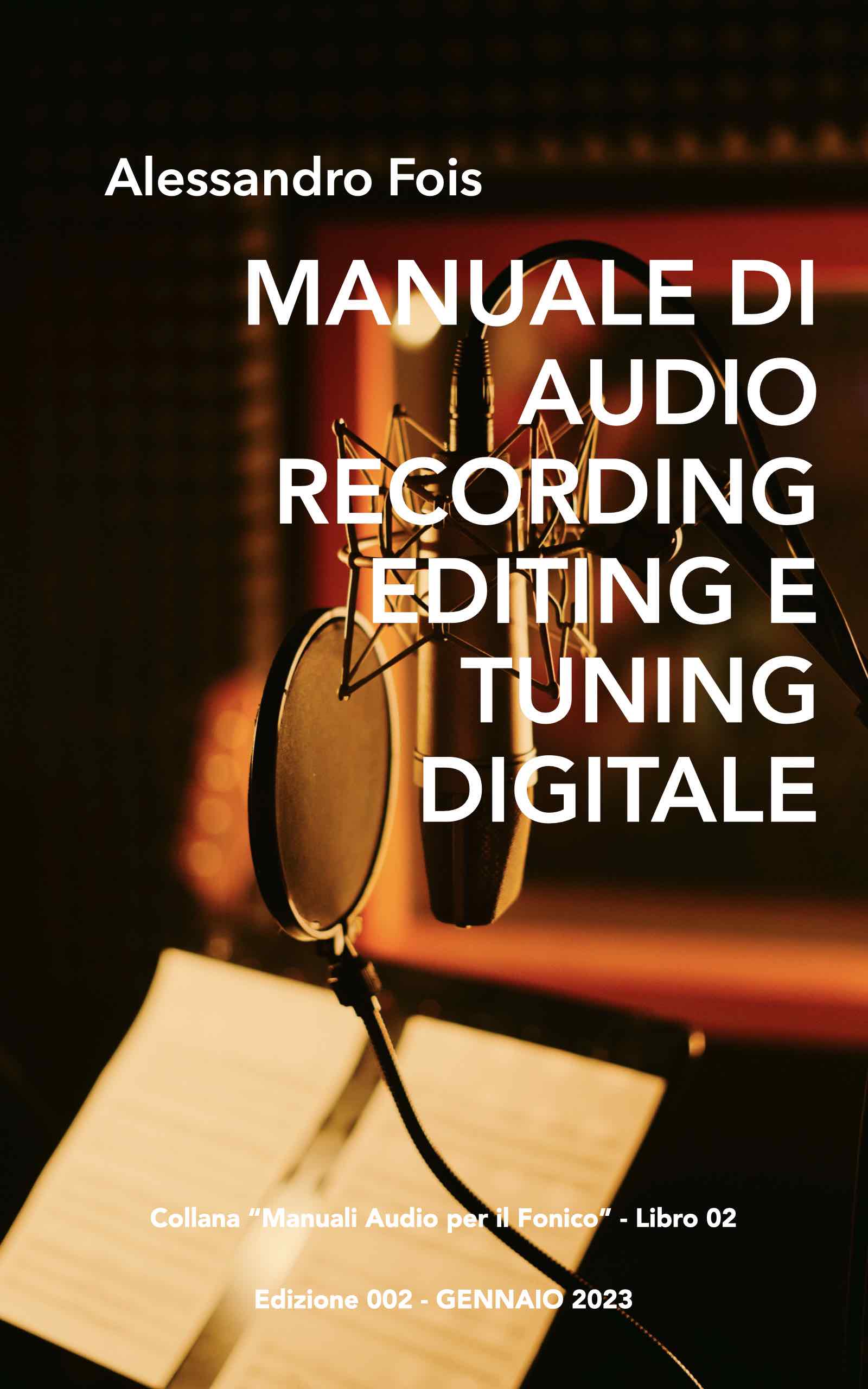
A Handbook on Digital Audio Recording, Editing and Tuning
 Italian
  English
  French
  Spanish
  German
Leave a Reply
Want to join the discussion?Feel free to contribute!